
Sensitive Eyes Lash Glue Reviews: Safe Adhesives Tested
Table of Contents
- What Causes Sensitive Eyes Reactions to Lash Glue
- Hypoallergenic Lash Glue: What Makes It Different
- Lash Glue Allergy Symptoms: How to Recognize a Reaction
- How to Apply Lash Glue Without Irritation
- Lash Extension Glue Safety Standards and Certifications
- Top Sensitive Eyes Lash Glue Options Compared
- Troubleshooting Poor Retention and Reactions
- Frequently Asked Questions
Last Updated: August 9, 2026
What Causes Sensitive Eyes Reactions to Lash Glue
Most lash extension adhesives use cyanoacrylate as their primary bonding agent. When cyanoacrylate polymerizes, it releases formaldehyde vapors and volatile compounds that trigger irritation, redness, or watering in sensitive eyes, often before the glue even touches skin.
Beyond the main ingredient, many formulations contain carbon black pigment, latex, or other additives that amplify irritation. Even "low-odor" formulas still release irritants; they're simply masked rather than eliminated.
Application conditions matter significantly. High humidity and poor ventilation accelerate polymerization and concentrate fumes around the eye. Temperature extremes also affect curing unpredictably, prolonging exposure and increasing irritation risk.
Individual sensitivity varies dramatically. Some people develop reactions after years of use, while others react immediately to specific ingredients. Conditions like blepharitis, rosacea, or contact lens wear amplify vulnerability.
The distinction between irritation and allergy matters. Irritation is temporary inflammation, redness, watering, mild burning that resolves within hours. Allergic reactions involve immune activation and worsen with repeated exposure, producing swelling, severe itching, or persistent discomfort lasting days.
Hypoallergenic Lash Glue: What Makes It Different
Hypoallergenic formulations remove or minimize ingredients most likely to trigger reactions. Formaldehyde-free formulas use alternative polymerization pathways that don't release this irritant. Latex-free adhesives eliminate a common allergen affecting roughly 1 in 100 people. Low-fume or fume-free formulas use encapsulation technology to minimize volatile compound release.
Viscosity also affects sensitivity. Thicker formulas cure more slowly, reducing fume intensity. Thinner formulas set faster but require faster application. Hypoallergenic products often use medium-thick viscosity as a compromise.
Pigment choice matters too. Carbon black irritates sensitive eyes; some hypoallergenic formulas use iron oxide or mineral pigments instead, or offer clear-drying versions.
Sensitive formulas deliberately cure slower, 3-5 seconds versus 1-2 seconds for standard adhesives. This reduces fume concentration and gives eyes time to adjust, though retention typically drops to 3-5 weeks rather than 5-7 weeks.
Hypoallergenic doesn't mean chemical-free. All extension adhesives require cyanoacrylate chemistry for professional retention. Hypoallergenic means optimized for tolerance, not elimination of chemistry.
Lash Glue Allergy Symptoms: How to Recognize a Reaction
Mild irritation appears within minutes: slight redness, watering, or scratchiness around the lash line. Most resolve within 30 minutes to an hour.
More pronounced reactions escalate quickly. Eyelid swelling, intense itching, significant redness, or burning sensation signal stronger response. Remove contact lenses immediately if wearing them, as they trap irritants against the cornea.
Severe allergic reactions are less common but serious. Persistent swelling worsening over hours, hives spreading beyond the eye area, difficulty opening the eye, or vision changes warrant immediate medical attention.
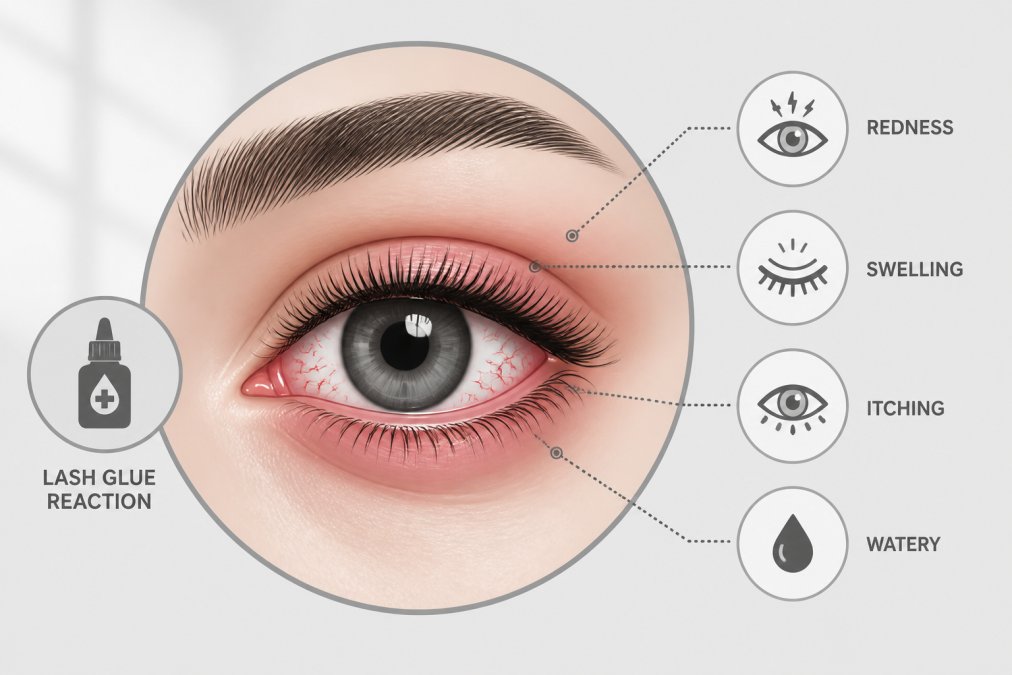
Timing distinguishes irritation from allergy. Irritation appears immediately and resolves within hours. Allergic reactions may develop over 24-48 hours as your immune system responds. Symptoms spreading beyond the eye area or appearing days after application indicate contact dermatitis rather than acute irritation.
Document your symptoms: note the adhesive used, when symptoms appeared, severity, and duration. This helps identify whether the problem is the glue, application technique, salon ventilation, or your individual sensitivity.
How to Apply Lash Glue Without Irritation
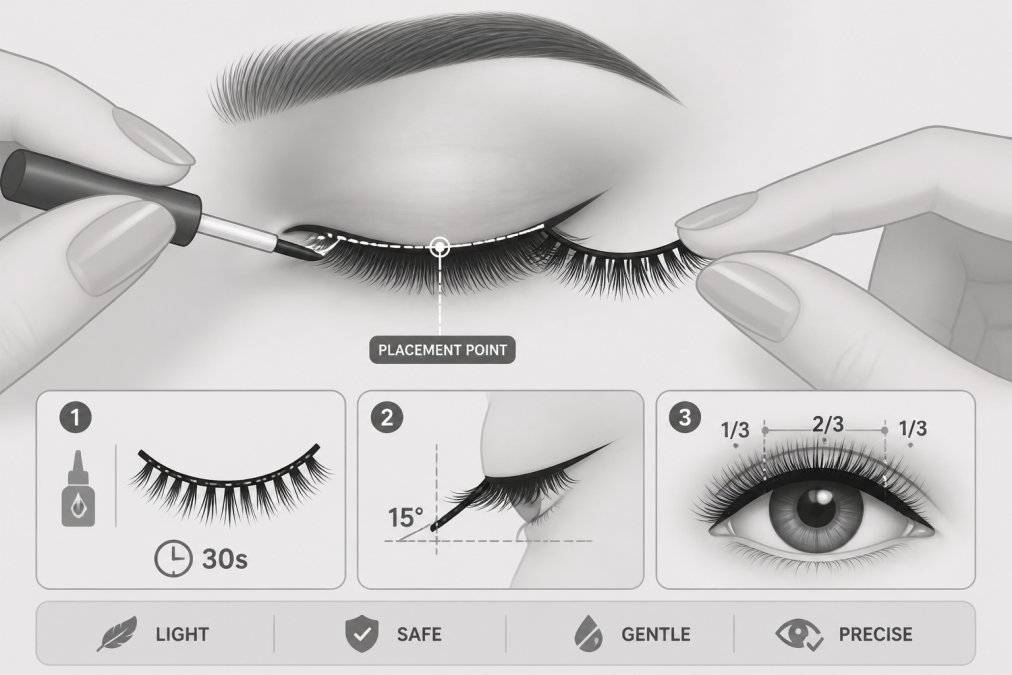
Use a tiny dot of glue, roughly pinhead-sized, at the lash base. Excess glue increases fume release and curing time without improving retention.
Place glue precisely at the junction where the extension meets the natural lash, not on skin or eyelid. Proper isolation prevents glue from running onto sensitive areas.
Work deliberately but efficiently. Hesitating while holding the glue-coated extension near the eye prolongs fume inhalation. Once placed, step back and let it cure.
Ventilation is non-negotiable. Open windows, use a fan, or work in well-ventilated space. Even basic air circulation reduces irritant concentration significantly.
Cooler, drier environments slow polymerization, spreading fume release over longer periods and reducing peak exposure. In summer heat or high humidity, work faster or use a slower-setting formula.
Patch test 24-48 hours before application. Apply a tiny amount to your inner wrist or behind your ear. If redness, itching, or hives develop, don't use that adhesive on your lashes.
Let adhesive cure fully before touching or wetting lashes. Most require 24 hours for complete cure, though they feel dry sooner. Avoid water, steam, or oil-based products during this window.
Lash Extension Glue Safety Standards and Certifications
The EU regulates cosmetic products including lash adhesives under REACH (Registration, Evaluation, Authorization and Restriction of Chemicals) legislation. Any adhesive sold in Europe must comply with REACH requirements for chemical safety and ingredient disclosure.
The EU Cosmetics Regulation (EC 1223/2009) sets specific restrictions on permissible ingredients. Formaldehyde is restricted but permitted in limited concentrations. Some ingredients banned in Europe remain legal in other markets, which is why European adhesives often feel gentler.
Reputable manufacturers provide Safety Data Sheets (SDS) documenting composition, hazard classifications, and safe handling. If a brand refuses to provide an SDS, that's a red flag. The SDS should specify whether the product is formaldehyde-free and latex-free.
Dermatological testing adds credibility. Some adhesives carry claims of being "dermatologically tested" or "hypoallergenic tested," indicating the manufacturer invested in safety validation.
Professional-grade adhesives are formulated for controlled salon environments with ventilation systems. Consumer DIY adhesives should have lower fume profiles for uncontrolled home settings. Using professional-grade adhesive at home increases irritation risk by default.
Top Sensitive Eyes Lash Glue Options Compared
1. Kyro Beauty Press-On Lashes (Glue-Free Alternative)
If you experience persistent reactions to any adhesive, Kyro Beauty's press-on lashes eliminate the problem entirely. These require no glue, they use a proprietary adhesive strip avoiding chemical fume exposure that triggers sensitivity.
No mixing, precise application, fumes, or curing time required. Press-on lashes adhere instantly and stay put through showers. Application takes seconds rather than 60-90 minutes for extensions. With 2000+ five-star reviews, the brand demonstrates consistent satisfaction.
Press-on lashes typically last 5-7 days with daily wear before losing adhesion, compared to 3-5 weeks for glued extensions. For sensitive eyes, this is a worthwhile exchange, you avoid chemical exposure and gain flexibility to remove lashes whenever desired.
Best for: Anyone with documented lash glue allergy or severe sensitivity, plus busy professionals prioritizing convenience.
Pros:
- No glue, fumes, or chemical irritation
- Super-fast application
- Shower-proof formula
- Salon-quality results at home
- Reusable and cost-effective
Cons:
- Shorter wear time than glued extensions
- Requires daily reapplication for continuous wear
2. Wimpern deLuxe Sensitive Eyelash Adhesive
Wimpern deLuxe is professional-grade adhesive specifically engineered for sensitive clients. The formulation is formaldehyde-free and minimizes fume release during curing.
The low-odor formula noticeably reduces chemical smell, indicating reduced volatile compound release. Works across classic, volume, and hybrid lashing techniques. Curing time of 2-4 seconds reduces overall exposure, though it requires precise application technique.
Requires strict environmental control: 20-24°C room temperature and 45-55% humidity. Professional salons maintain these routinely, but home application becomes challenging in variable conditions.
Best for: Professional lash technicians working with sensitive clients in controlled salon environments.
Pros:
- Formaldehyde-free reduces irritation
- Low-odor formula improves comfort
- Fast curing reduces exposure time
- Professional-grade retention
Cons:
- Requires specific environmental conditions
- Not suitable for DIY home application without climate control
3. Noble Lashes Sensitive Glue
Noble Lashes offers an accessible option for sensitive-eye clients. The hypoallergenic formula uses mild composition with thick viscosity, making it beginner-friendly while remaining professional-grade.
Thick consistency is easier to control during application and less likely to run onto skin. Slower drying time (3-5 seconds) gives wider application window, reducing stress and rushed technique. Retention of 3-5 weeks is shorter than standard adhesives but acceptable for sensitive clients.
Requires monitoring of humidity and temperature for optimal performance. In uncontrolled home environments, retention becomes unpredictable.
Best for: Clients with sensitive eyes seeking professional-grade retention without extreme environmental demands.
Pros:
- Mild, hypoallergenic formula
- Thick consistency aids precision
- Slower drying time suits beginners
- Low fume level
- Reasonable retention
Cons:
- Shorter retention than standard adhesives
- Environmental conditions still affect performance
4. Smart Lashes Sensitive Glue
Smart Lashes offers fume-free black adhesive for clients with mild allergies. This is the most accessible option for home use, engineered for uncontrolled environments. The fume-free composition genuinely minimizes volatile compound release.
Meets EU standards with proper safety documentation. Shelf life of 2 months after opening is standard for sensitive formulas. Storage requirements are straightforward: cool and dry between 5-25°C at 50% humidity, easier to maintain at home than professional formulas.
Best for: Professional technicians with mildly allergic clients, and DIY users seeking fume-free options for home application.
Pros:
- Fume-free composition reduces irritation
- Certified for cosmetic use
- Easy storage requirements
- Black color for visibility
Cons:
- Shorter shelf life after opening
- Not suitable for severe allergic reactions
5. iLevel Lab Sensitive Adhesive
iLevel Lab produces extremely gentle hypoallergenic adhesive for highly sensitive eyes or documented allergies. Latex-free and formaldehyde-free removes two common allergens. Setting time of 3-4 seconds gives control without speed stress.
Retention of 1-2 weeks is significantly shorter than other sensitive formulas. For severe sensitivities, this is acceptable, you prioritize comfort over longevity. Reduced retention also means less chemical exposure over time.
Optimal conditions are moderate: 15-24°C and 50-70% humidity, more forgiving than professional formulas and better for home application.
Best for: Clients with highly sensitive eyes or documented allergies to latex or formaldehyde.
Pros:
- Extremely gentle, hypoallergenic formula
- Latex and formaldehyde-free
- Low odor and fume
- More forgiving environmental requirements
Cons:
- Significantly shorter retention (1-2 weeks)
- Higher cost than standard sensitive formulas
Troubleshooting Poor Retention and Reactions
Humidity below 45% causes adhesive to cure too quickly and become brittle. Humidity above 60% slows curing and creates weak bonds. Temperature outside 18-24°C affects polymerization. These conditions are difficult to control precisely at home.
Poor retention also signals application technique issues. Insufficient glue means weak bonds; too much creates unstable connections. Glue must sit exactly at the lash base. Improper isolation or shedding within days indicates technique problems.
Oil-based products, makeup removers, and serums break down adhesive bonds. Water exposure in the first 24 hours disrupts curing. Rubbing, pulling, or sleeping face-down weakens retention. Proper aftercare extends retention by days or weeks.
If reactions persist despite using sensitive formula, consider ventilation, specific ingredient sensitivities, and whether you've had a patch test. Switching adhesives is reasonable if you've had consistent reactions, not all sensitive formulas work for all people.
For mild irritation, remove lashes immediately, rinse with cool water, and avoid adhesive for 24-48 hours. For severe reactions with persistent swelling, vision changes, or spreading rash, seek medical attention.
Choosing a sensitive eyes lash glue depends on your specific sensitivity and lifestyle. If you've experienced severe reactions, Kyro Beauty's press-on alternative eliminates chemical exposure while delivering salon-quality results. For semi-permanent extensions, professional-grade sensitive formulas like Wimpern deLuxe or Noble Lashes offer balanced retention with minimal irritation in proper conditions.
For home application without strict environmental control, Smart Lashes or iLevel Lab provide forgiving formulations designed for variable conditions. Start with a patch test, apply in well-ventilated space, and monitor your eyes carefully during the first 24 hours. Your comfort matters more than retention, if an adhesive irritates you, it's the wrong choice.
EU Cosmetics Regulation guidelines on ingredient safety
REACH chemical safety requirements for cosmetic products
Dermatological guidance on contact allergies and lash products
Frequently Asked Questions
Which lash glue is best for sensitive eyes?
Formaldehyde-free, hypoallergenic adhesives with low fume levels work best for sensitive eyes. Look for products labeled latex-free and tested for minimal irritation. Wimpern deLuxe, Noble Lashes, and Smart Lashes all offer sensitive formulas. Alternatively, glue-free options like Kyro Beauty press-on lashes eliminate chemical exposure entirely, making them ideal if you've had severe reactions in the past.
How do I know if I'm allergic to lash glue?
Common lash glue allergy symptoms include redness, itching, swelling around the eye area, watery eyes, and a burning sensation that appears within hours or days of application. Some people develop blepharitis or a rash on the eyelid. If you experience these signs, remove the lashes immediately and avoid that product. Always perform a patch test on a small area 24 hours before full application to check for reactions.
Does sensitive eyelash glue actually work, or is it just marketing?
Sensitive lash glues do work when formulated without harsh chemicals like formaldehyde and cyanoacrylate derivatives. Products with slower drying times (3-5 seconds) and lower fume levels allow safer application. However, retention may be shorter (3-5 weeks instead of 6-8 weeks) compared to standard glues. The trade-off is worth it if you experience irritation with regular adhesives, reduced reaction risk outweighs slightly faster reapplication cycles.
Can I use regular lash glue if I have sensitive eyes?
Not recommended. Standard lash glues contain cyanoacrylate and formaldehyde-releasing agents that trigger irritation in sensitive eyes. Even if you've tolerated regular glue before, sensitivity can develop over time. Always choose adhesives specifically labeled hypoallergenic and formaldehyde-free. If you have a history of severe reactions, consider glue-free alternatives like press-on lashes that eliminate chemical exposure risk.
What should I do if I have a reaction after applying lash glue?
Remove the lashes immediately and rinse your eye area gently with cool water. Avoid touching or rubbing the eye. If redness or swelling persists beyond a few hours, apply a cool compress and consider using a mild antihistamine cream. If symptoms worsen or vision is affected, seek medical attention. For future applications, perform a patch test 24 hours before use, apply in a well-ventilated area, and allow proper curing time before eye contact.
