



Are Professional Lash Treatments Safe for Natural Lashes?

Table of Contents
- What Professional Lash Treatments Actually Do to Your Natural Lashes
- The Safety Data: What the Research Really Shows
- How Long Do Lash Lifts Last and What Happens After?
- Signs of Damaged Eyelashes and When to Stop Treatment
- How to Prevent Lash Damage from Extensions and Lifts
- Lash Lifts vs. Lash Extensions: Which Poses Less Risk?
- What to Look for in a Safe Salon or At-Home Kit
- Frequently Asked Questions
Last Updated: September 22, 2026
What Professional Lash Treatments Actually Do to Your Natural Lashes
Professional lash treatments safe when applied correctly, whether lifts or extensions, work by chemically altering the structure of your natural lashes. A lash lift uses a lifting solution containing alkaline perming agents that break down the disulfide bonds in your lash's protein structure, allowing the hair to be reshaped around a silicone rod. Extensions, by contrast, add synthetic fibres bonded to each natural lash with cyanoacrylate-based adhesive, increasing weight and stress on the follicle.
The key difference lies in permanence and mechanism. Lash lifts are semi-permanent, lasting 6-8 weeks as your natural lash cycle progresses through its anagen, catagen, and telogen phases. Extensions persist until they shed with your natural lash cycle, typically 4-6 weeks, though many people reapply before that point. Both treatments place demands on lash health, but in different ways.
According to research from the National Center for Biotechnology Information, 73.3% of patients experienced ocular side effects after eyelash extension application, with 45.8% reporting itching specifically. This isn't a rare outcome, it's the norm. Understanding what happens chemically helps you make an informed decision about whether either treatment suits your lash type.
The Safety Data: What the Research Really Shows
The safety picture is more nuanced than "safe" or "unsafe." Over 85% of clients report satisfaction with lash lift results, according to the Professional Beauty Association's 2025 client satisfaction data, and less than 2% experience adverse reactions to professional-grade lash lifts when applied correctly. That's genuinely reassuring.
But satisfaction doesn't equal safety for your lashes' long-term health. A client can feel happy with their results while their lashes are experiencing cumulative damage from repeated treatments. Understanding the chemistry behind these treatments reveals why.
How lifting solutions affect lash protein structure
Lash lift solutions work by breaking disulfide bonds, the chemical links that give your hair its shape and strength. Most professional lifting solutions contain thioglycolic acid or similar alkaline agents (typically pH 9-11) that penetrate the hair cortex and temporarily weaken these bonds. When the lash is wrapped around a silicone rod during processing, the bonds reform in the new curved position. This is why timing is critical: leaving the solution on too long (beyond 10-15 minutes for most formulations) over-processes the protein structure, causing permanent brittleness and breakage that can't be reversed.
The risk multiplies with repeated applications. Each lash lift weakens the protein matrix slightly. After 3-4 consecutive lifts without a 6-8 week break, the cumulative effect becomes visible: lashes feel dry, snap easily, and appear noticeably thinner. This isn't an allergic reaction; it's structural degradation of the hair itself.
Extension adhesives and contact dermatitis
Lash extension adhesives are cyanoacrylate-based formulas, the same chemistry as super glue. When cyanoacrylate contacts moisture (including the natural moisture around your eye), it polymerizes and hardens instantly. This is why extensions bond so strongly, but it's also why they trigger reactions.
The polymerization process releases formaldehyde as a byproduct. Research from the National Center for Biotechnology Information found that 73.3% of extension wearers developed ocular side effects, with contact dermatitis being the most common. This isn't rare sensitivity; it's a predictable chemical response in roughly 1 in 3 people.
The patch test: your first line of defence
How Long Do Lash Lifts Last and What Happens After?
A lash lift lasts 6-8 weeks because it works with your natural lash cycle. Your lashes shed continuously, roughly 1-5 lashes per eye per day under normal conditions. As new lashes grow in unlifted, the curl gradually relaxes. By week 8, most of the lifted lashes have shed and been replaced by new growth, so the effect fades naturally.
Signs of Damaged Eyelashes and When to Stop Treatment
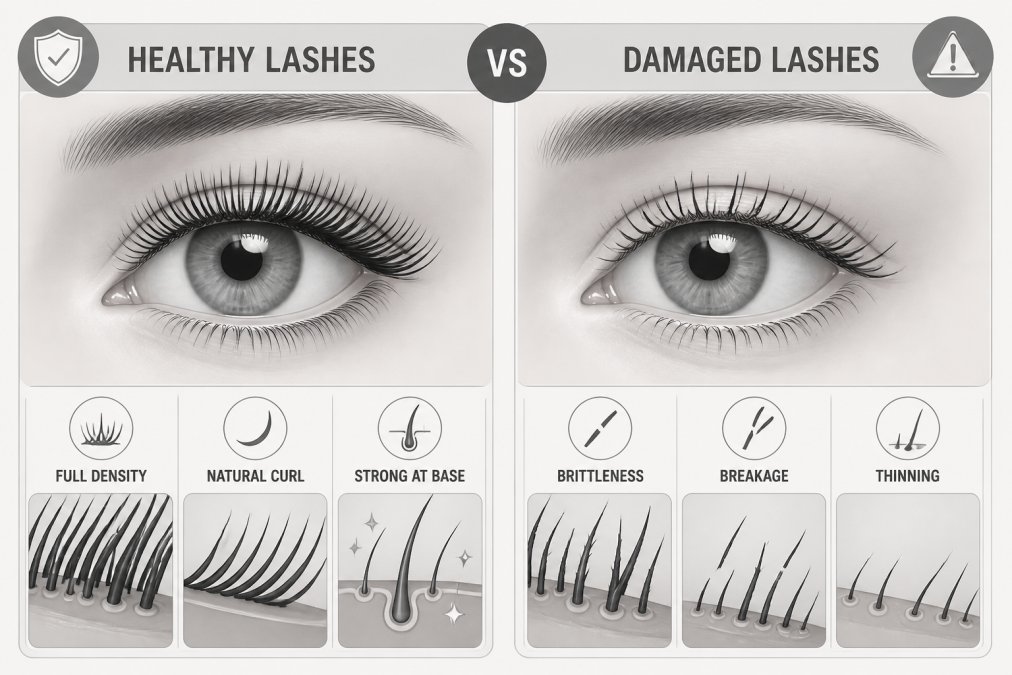
Lash damage manifests in specific, observable ways. Brittleness is the first sign, your lashes feel dry and snap when you touch them. Breakage appears as shorter lashes mixed with your normal length, often clustered near the lash line. Thinning is harder to notice initially but becomes obvious when you look at your lash line in bright light, it appears sparser than before.
How to Prevent Lash Damage from Extensions and Lifts
Prevention starts with choosing a certified technician, non-negotiable. A certified professional understands lash anatomy, knows how to perform a patch test, and uses sterile equipment and hypoallergenic formulations. They'll assess your lash type and eye sensitivity before proceeding.
Ingredient transparency: what to ask for
- pH-balanced (8.5-9.5 range). Solutions above pH 10 are too alkaline and over-process lashes rapidly.
- Paraben-free. Parabens can accumulate in hair and weaken protein bonds over time.
- Free of heavy metals (lead, cadmium, mercury). These are sometimes found in cheaper formulations and can damage follicles with repeated exposure.
- Formulated with conditioning agents. Look for solutions that include keratin, panthenol, or amino acids to minimize protein loss during processing.
For extensions, ask about the adhesive:
- Formaldehyde content. Most professional adhesives release 0.5-2 ppm (parts per million) during curing. Lower is better; ask if the salon uses a "low-formaldehyde" or "formaldehyde-free" option (though true formaldehyde-free cyanoacrylate adhesives are rare and often less durable).
- Curing time. Adhesives that cure in 24-48 hours are gentler than those requiring 72+ hours, as they give your eye time to stabilize before full polymerization.
- Removal method. Ask how extensions are removed. Responsible salons use a dedicated adhesive remover (usually a gel-based solution) rather than pulling extensions off manually, which damages your natural lash.
Post-treatment recovery protocol: the critical 72-hour window
For lash lifts:
- Avoid water for 24 hours. Water penetrates the hair shaft and can weaken the newly reformed disulfide bonds before they fully set.
- Start conditioning on day 3. Use a lash-specific conditioning serum (containing keratin, panthenol, or biotin) 3-4 times weekly for the next 6 weeks. This restores moisture and reinforces protein structure. Apply the serum to the lash line and mid-shaft, avoiding the roots to prevent product buildup.
- Avoid oil-based makeup removers. Oil breaks down the curl faster by penetrating the hair shaft. Use a gentle, water-based cleanser instead.
For extensions:
- Avoid water for 48 hours. Cyanoacrylate adhesive needs time to fully cure; water exposure during this window can weaken the bond.
- Clean daily after 48 hours. Use a gentle, oil-free lash cleanser and a soft brush to remove debris and bacteria. Poor hygiene is the leading cause of blepharitis in extension wearers.
- Condition 3-4 times weekly. Extensions add weight to your natural lash; conditioning serum supports the follicle's ability to sustain that stress.
- Remove extensions professionally every 3-4 weeks. Never pull extensions off yourself. Professional removal takes 15-20 minutes and uses a dedicated adhesive remover that dissolves the bond without damaging your natural lash.
Spacing between treatments: the non-negotiable recovery window
- Protein regeneration. Your hair naturally produces new keratin and structural proteins; this process takes 4-6 weeks after chemical processing.
- Follicle stabilization. The follicle (the living tissue beneath the lash) experiences stress during treatment. Recovery time allows inflammation to subside and blood flow to normalize.
- Moisture rebalancing. Lashes lose moisture during chemical processing; 6-8 weeks allows natural oils to redistribute through the hair shaft.
Lash health maintenance between treatments
- Keratin (rebuilds protein structure)
- Panthenol (attracts and retains moisture)
- Biotin (supports follicle health)
- Peptides (strengthen hair bonds)
Lash Lifts vs. Lash Extensions: Which Poses Less Risk?
Lash lifts carry lower risk for most people. They don't involve adhesive, so allergic reactions are rare. They don't add weight, so mechanical stress on follicles is minimal. The main risk, over-processing, is entirely within your technician's control. A skilled professional using appropriate lifting solutions and timing protocols can perform lifts safely on almost anyone, even those with sensitive eyes.
| Treatment | Allergic Reaction Rate | Weight Stress | Reversibility | Recovery Time |
|---|---|---|---|---|
| Lash Lift | <2% | None | No | 6-8 weeks |
| Lash Extensions | ~33% | High | Yes | 3-7 days |
What to Look for in a Safe Salon or At-Home Kit
A safe salon performs a patch test before any treatment, maintains sterile equipment, and uses formulations with transparent ingredient lists. Ask about their lash lifting solution, it should be pH-balanced and paraben-free. For extensions, ask about the adhesive brand and whether they've had clients report sensitivities.
Frequently Asked Questions
Are professional lash treatments safe for natural lashes?
Professional lash treatments carry documented risks. Less than 2% of clients experience adverse reactions to professional lash lifts when performed correctly, but eyelash extensions show higher concern rates: 73.3% of patients reported ocular side effects including itching and irritation. Safety depends on technician certification, ingredient quality, patch testing, and proper aftercare. Lash lifts generally pose lower risk than extensions because they don't add weight or require adhesive.
How long do lash lifts last and can they damage lashes over time?
Lash lifts typically last 6-8 weeks, aligning with your natural lash growth cycle. Over-processing or repeated treatments without adequate recovery periods between cycles can weaken the protein structure of lashes, leading to brittleness and breakage. Spacing treatments at least 6-8 weeks apart and using conditioning serums between appointments significantly reduces cumulative damage risk.
What are the signs of damaged eyelashes from professional treatments?
Watch for brittleness, premature breakage, thinning density, loss of curl retention, and itching or redness around the lash line. If you notice lashes snapping off easily, gaps appearing in your lash line, or persistent eye inflammation after treatment, stop treatments immediately and consult a dermatologist. These signals indicate your lashes need recovery time before any further professional enhancement.
How can I prevent lash damage from extensions and lifts?
Choose certified technicians who use hypoallergenic, paraben-free formulations and perform patch tests before treatment. Space treatments 6-8 weeks apart to allow lashes to complete their growth cycle. Use conditioning serums with keratin and protein between appointments, avoid rubbing your eyes, and remove makeup gently with oil-free cleansers. At-home kits without adhesive, like press-on lashes, can reduce adhesive-related damage.
