



Safest Ingredients for Brow Lamination: A 2026 Guide

Table of Contents
- How the Brow Lamination Process Works
- Key Ingredients in Brow Lamination Solutions
- Brow Lamination Patch Test Instructions
- Nourishing Additives and Oils That Support Brow Health
- Ingredients to Avoid for Sensitive Skin and Long-Term Brow Integrity
- How Long Does Brow Lamination Last and What Affects Longevity
- Brow Lamination Aftercare Tips for Lasting Results
- Frequently Asked Questions
Last Updated: September 16, 2026
How the Brow Lamination Process Works
Brow lamination is a chemical straightening treatment that restructures brow hairs into a uniform, fuller shape, and the safest ingredients for brow lamination are the ones that lift the hair gently, neutralise completely, and leave the skin barrier intact. The process relies on breaking disulfide bonds inside each hair, then resetting them in a new position.
A lifting solution opens the hair cuticle and softens those bonds. A neutralising agent then rebuilds them. Because the product sits on skin for several minutes, ingredient choice matters as much as technique.
peer-reviewed analysis of thioglycolate compounds in brow lamination confirms that thioglycolate compounds sit at the centre of this technique.
That is the mechanism. What follows is where most guides stop short: which specific ingredients carry the most risk, and how to read a label before it touches your brows.
Key Ingredients in Brow Lamination Solutions
Most professional kits contain three functional groups: the lifting agent, the neutraliser, and preservatives that keep the formula stable. Understanding each group tells you where sensitivity usually starts.
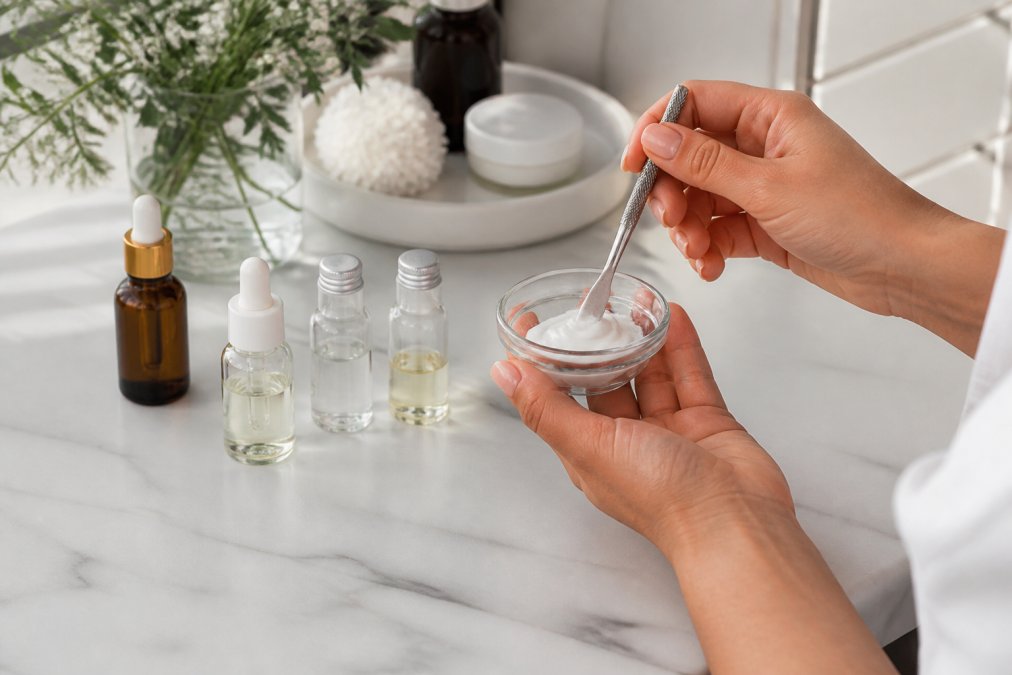
Thioglycolate and Cysteamine
Thioglycolate is the traditional lifting agent, effective but alkaline and known to irritate sensitive skin. Cysteamine is the newer alternative, and 2026 industry guidance points to it as the more tolerable option for a range of hair types because it works at a more moderate pH. If your skin reacts easily, a cysteamine-based lifting solution is the safer starting point.
Neutralizing Agents and Preservatives
Sodium bromate is a common neutralising agent, and 2026 buying guidance recommends choosing kits that are explicitly sodium bromate-free. Preservatives are harder to avoid: many professional formulas rely on quaternary ammonium compounds to control bacteria, which complicates any claim that a product is entirely "clean". A preservative-free lamination solution is not realistic. A well-preserved one is.
Brow Lamination Patch Test Instructions
A patch test is a 24 to 48 hour check in which a small amount of lifting solution is applied to a discreet area of skin to see whether it reacts. It is the single most useful safety step, and it takes two minutes.
- Clean a small patch behind your ear or on your inner forearm.
- Apply a drop of lifting solution and a drop of neutraliser separately, about 2 cm apart.
- Leave both for the full processing time stated on the kit.
- Rinse with lukewarm water and pat dry.
- Wait 24 to 48 hours. Check for redness, itching, swelling, or a rash.
Any reaction means stop. Contact dermatitis can develop on the second exposure even when the first test was clear, so repeat the test before every new kit.
Nourishing Additives and Oils That Support Brow Health
Conditioning ingredients do not lift hair, but they decide how your brows look two weeks later. The useful way to judge them is not by the label claim but by what they do to the hair shaft after the disulfide bonds have been broken.
Lifting agents leave the cuticle raised and the cortex depleted of the lipids and proteins that normally hold moisture in. A good aftercare additive replaces some of that. A poor one just coats the surface.
What each class of ingredient actually does
- Peptides (hydrolysed wheat, silk, or keratin peptides). These are short amino acid chains small enough to sit on and partially penetrate the damaged cuticle. They do not rebuild disulfide bonds, but they form a film that reduces moisture loss and improves tensile strength, which is why brows feel less brittle after a few days of use.
- Vitamin E (tocopherol). A fat-soluble antioxidant that slows oxidative stress in the hair and surrounding skin. It is not a repair agent on its own; it works best alongside an occlusive oil that keeps it in contact with the hair.
- Castor oil. High in ricinoleic acid, which gives it a thick, tacky consistency that clings to the hair shaft and adds visible shine. It is occlusive rather than penetrating, so it seals moisture in rather than adding it.
- Argan oil. Rich in oleic and linoleic acids plus tocopherols. Lighter than castor and absorbs faster, which makes it the better choice for daytime use on brows that need to hold a brushed shape.
- Jojoba oil. Technically a wax ester, and its structure closely resembles human sebum. That makes it well tolerated on the brow bone and less likely to leave a heavy film than castor.
- Panthenol (provitamin B5). A humectant that draws water into the hair and skin. Common in professional aftercare serums because it is lightweight and does not interfere with the set once the first 48 hours have passed.
The interaction that matters most
The reason peptides and Vitamin E appear together in almost every reputable aftercare serum is that they compensate for different parts of the same damage. The lifting agent strips lipids and raises the cuticle; peptides address the protein side, and oils plus tocopherol address the lipid and oxidative side. Using one without the other leaves half the problem unaddressed.
This is also why a nourishing additive cannot rescue an over-processed brow. If the lifting solution was left on too long or was too alkaline, no amount of castor oil will restore the disulfide bonds that were destroyed rather than rearranged. Conditioning is maintenance, not repair.
The oil-timing disagreement, resolved
Some practitioners warn that oil-based products leave a film that interferes with the lamination effect, while others recommend them for nourishment. Both are describing the same chemistry from different angles. In the first 24 to 48 hours the hair is still re-forming its new bond structure, and an oil film can physically block the neutraliser from finishing its work or weigh the hairs down before the shape sets. After that window, the bonds are stable and oils do nothing but help.
The practical rule: keep oils off the brow area for the first 24 to 48 hours, then use them freely. If you want nourishment during the setting window, choose a water-based panthenol or peptide serum instead.
Ingredients to Avoid for Sensitive Skin and Long-Term Brow Integrity
The ingredients most likely to cause problems are active skincare acids, retinol, and high-alkaline lifting formulas. If you are using retinol, AHAs, or BHAs, 2026 safety guidance advises against lamination entirely until you have stopped, because these increase skin sensitivity and the risk of an adverse reaction. Prioritizing a barrier-repairing approach to skincare for sensitive skin helps stabilize the brow area before any chemical restructuring takes place.
But knowing the names is only half the job.
How to read an INCI list on a brow product
Ingredients are listed in descending order of concentration, with anything present at 1% or less allowed to appear in any order after that point.
The avoid-list, with reasons
- Sodium bromate as a neutralising agent. Effective, but a recognised irritant and the ingredient most commonly flagged in safety guidance.
pH balance and skin barrier health
pH is the variable most guides ignore, and it is the one that decides whether a treatment stings.
Long-term cumulative damage
How Long Does Brow Lamination Last and What Affects Longevity
Brow lamination typically lasts four to six weeks, depending on your hair growth cycle, how well you follow aftercare, and how strong the lifting solution was.
Brow Lamination Aftercare Tips for Lasting Results
Our all-in-one kits include shaping and tinting, and the formulas are designed to be gentle on sensitive eyes.
Frequently Asked Questions
What ingredients should be avoided in brow lamination kits?
Avoid ammonia, sodium bromate, and high concentrations of thioglycolic acid, as these can irritate sensitive skin. Also skip oil-based aftercare products like castor oil immediately after treatment, because they leave a film that interferes with the lamination effect. For sensitive skin, steer clear of products with strong fragrances or alcohol, which can dry out the brow area and cause contact dermatitis. Always check labels for these ingredients before purchasing a kit.
Is brow lamination safe for sensitive skin?
Yes, if you choose formulas that are ammonia-free, thio-free, and enriched with soothing botanicals like aloe or chamomile. Cysteamine-based solutions are more tolerable for various hair types and operate at a moderate pH, reducing irritation risk. Always perform a patch test 24-48 hours before your first full treatment. If you use active skincare ingredients such as retinol, AHAs, or BHAs, pause them before lamination to avoid increased sensitivity.
How do I perform a patch test for brow lamination products?
Cleanse a small area behind your ear or on your inner forearm. Apply a tiny amount of the lifting solution and neutralizer, following the kit instructions. Leave it on for the recommended time, then rinse. Wait 24-48 hours and check for redness, itching, or swelling. If any reaction occurs, do not proceed with the full treatment. Even if you have used the product before, repeat the patch test with each new kit, as formulas can change.
Are there natural alternatives to chemical brow lamination?
Some kits now use cysteamine, a gentler alternative to thioglycolic acid, and include botanical extracts like aloe and chamomile. However, completely natural lamination is not possible because the process requires a chemical agent to break disulfide bonds in the hair. You can support brow health with nourishing ingredients such as castor oil, peptides, and vitamin E after the treatment has set. Always prioritize products that are free from ammonia and sodium bromate.
Brow lamination rewards patience more than technique. Read the label, patch test every time, and treat the 48 hours after treatment as part of the process rather than an inconvenience. Kyro Beauty builds kits with gentle formulas, shower-proof results, and no glue required, so you can shape and tint your brows at home without guessing what is in the bottle. Shop the Kit and see what a controlled, well-labelled lamination routine looks like.
