
Can You Reuse Press-On Eyelashes? The 2026 Guide

Table of Contents
- Can You Reuse Press-On Eyelashes? What You Need to Know First
- How to Clean Press-On Lashes Without Damaging the Band
- How Long Do Press-On Lashes Last?
- Do Press-On Lashes Look Natural After Reuse?
- Hygiene and Eye Health: What to Check Before Every Reuse
- How to Store Your Lashes So They Last Longer
- Frequently Asked Questions
Last Updated: September 16, 2026
Can You Reuse Press-On Eyelashes? What You Need to Know First
Yes, you can reuse press-on eyelashes, but only if you remove, clean, and store them correctly between wears. The global false eyelashes market was valued at $1.60 billion in 2025 and is projected to reach $3.22 billion by 2034, according to Fortune Business Insights market report, and a large share of that growth comes from people who want salon-style results without a salon bill every few weeks. That is exactly the space Kyro Beauty works in, and it is why the reuse question comes up so often.
Here is the honest answer most brands avoid: reusability is not a fixed property of the product. It is a property of how you treat the product.
When Reuse Is Safe and When It Is Not
Reuse is safe when the lash band is still intact, the fibers are clean, and no adhesive residue has built up near the base. It is not safe when the band has warped, when fibers have shed, or when you cannot remember the last time you cleaned them.
The industry disagrees here.
The Three-Tier Reuse Rule
We group press-on lashes into three practical tiers, because "reusable" means very different things depending on what you bought:
| Lash Type | Typical Reuse Window | Main Limiter |
|---|---|---|
| Strip / press-on with no glue | 5-10 wears with care | Band flexibility |
| DIY lash clusters | Up to 3 wears | Adhesive buildup |
| Single-use press-ons | 1 wear only | Designed adhesive |
How to Clean Press-On Lashes Without Damaging the Band
Cleaning press-on lashes takes about two minutes and no special equipment. The goal is to lift adhesive and oils off the band without soaking the fibers long enough to distort them.
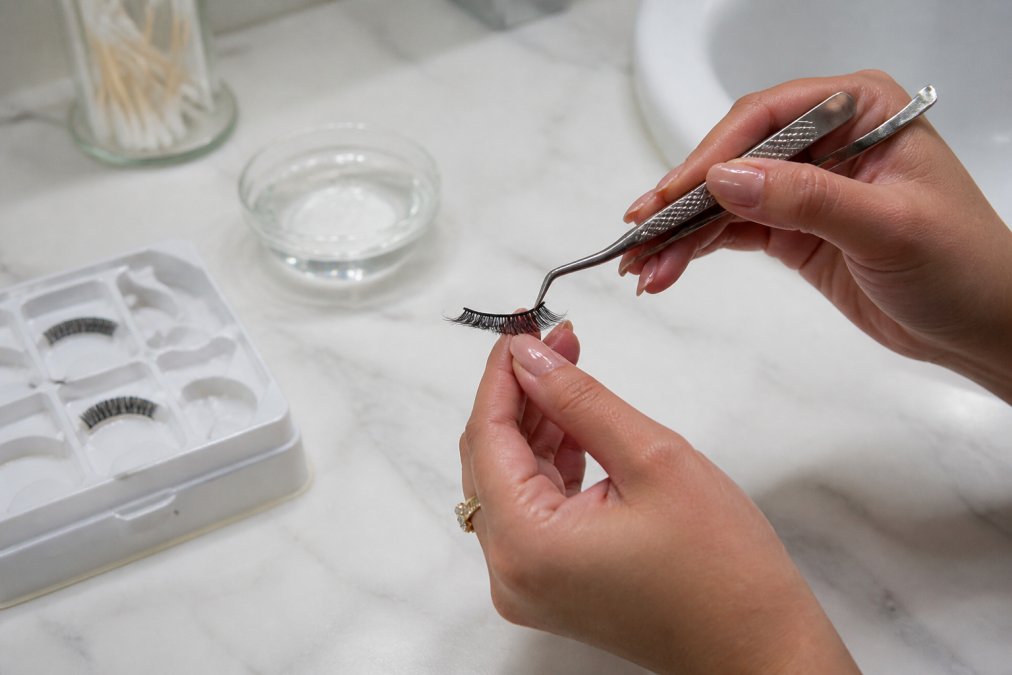
Work through these steps:
- Peel the lash off starting from the outer corner, using your fingers or a pair of tweezers. Never pull from the middle.
- Lay the lash face-down on a clean tissue so the curl is not compressed.
- Dampen a cotton bud with micellar water or an oil-free makeup remover. Avoid oil-based cleanser on the band, since oil breaks down the adhesive layer you want to keep intact.
- Wipe along the band in one direction, not back and forth. Back-and-forth motion is what frays the band edge.
- Use tweezers to pick off any remaining adhesive residue in small flakes rather than scraping it.
- Let the lash air-dry fully, band-side up, for at least 15 minutes before it goes anywhere near a storage case.
Removing Adhesive Residue Safely
Adhesive residue is the biggest reason reusable lashes stop looking good: once it builds up on the band, the next application sits unevenly and the lash lifts at the inner corner within hours.
How Long Do Press-On Lashes Last?
Press-on lashes last 5 to 10 wears when cleaned and stored properly, and 1 to 3 when they are not. The variable is your routine, not the lash.
Three things shorten lifespan faster than anything else:
- Sleeping in them. The band creases against the pillow and never fully recovers its curve.
- Storing them loose in a makeup bag. Fibers tangle, and untangling pulls them out.
- Cleaning with oil-based products. Oil degrades the adhesive layer that keeps the band structured.
Material-Specific Reuse Guidelines
Most guides treat "reusable lashes" as one category. They are not. Fiber and band material determine how the lash fails and how many wears you get, so match your cleaning method to the material rather than a generic tutorial. Maintaining the structural integrity of these delicate fibers requires the same level of precision as cleaning reusable eye accessories to prevent the buildup of debris that compromises both hygiene and lash longevity.
Do Press-On Lashes Look Natural After Reuse?
Press-on lashes look natural after reuse if the band keeps its shape and the fibers keep their curl. Once either goes, the lash reads as "false" from close range, no matter how well you apply it.
Visual Indicators of Wear
Check these before every reuse. If you see two or more, retire the pair:
- The band no longer lies flat when you hold it straight
- Fibers have separated into visible gaps
- The curl has dropped by roughly a third or more
- Adhesive residue has turned dark or gummy
- The lash has developed a permanent bend from storage
Hygiene and Eye Health: What to Check Before Every Reuse
Hygiene separates a safe lash reuse routine from a risky one. Bacterial growth on a lash band is invisible, which is why the routine must be consistent, not occasional.
Before every reuse, run this checklist:
- Band is fully dry, with no lingering moisture
- No visible residue on the band or near the base of the fibers
- Lash has been stored in a closed case, not loose
- No redness, itching, or irritation after the previous wear
- Adhesive or bond and seal is fresh, not from an opened tube older than a few months
Allergic Reaction Risks
Adhesive, not fibers, is the usual culprit behind lash-line irritation. If you have reacted to lash glue before, patch-test any new bond or seal on your inner forearm 24 hours before it goes near your eye. Reusing a lash with old adhesive attached raises the risk, since you are reapplying a substance your skin has already had prolonged contact with.
How to Store Your Lashes So They Last Longer
Storage decides how many wears you actually get. A lash stored flat in a closed case with its curve intact outlasts an identical lash kept loose in a bag by several wears. The band is a shaped material that holds a memory of its curve, and anything pressing it out of shape forces it to fight back into position on the next application.
The basics:
- Return each lash to its original tray or a dedicated storage case
- Keep the case closed to block dust and lint
- Store away from direct sunlight and heat, both of which soften the band
- Keep left and right separated so you are not guessing which is which
- Never stack lashes on top of each other
Why Storage Fails More Often Than Cleaning
Three storage mistakes account for most shortened lifespans:
Compression. Stacking lashes or pressing them under other items flattens the curl, and no amount of cleaning brings it back. Store lashes so nothing rests on top of them.
The Storage Setup That Actually Works
You do not need a specialist kit, just hold the lash in its natural curve, protect it from compression, and keep it dry.
- Keep the original tray if it has a shaped well for each lash. That well exists to hold the curve, so use it.
- If the tray is gone, a compartmented case with a flat base works, provided each lash sits in its own section.
- Keep the case somewhere cool and out of direct light, not on a sunny shelf.
- Make sure lashes are fully dry before they go in. Sealing a damp lash into a closed case is how you get the musty smell and dark residue that signals bacterial growth.
If you rotate between two or three pairs, label the compartments. Rotating pairs gives each one more recovery time between wears, and a labelled case stops you from mixing up a well-worn pair with a fresh one.
Storage is half of what determines your wear count. Hold the curve, avoid compression, keep it dry and cool, and a lash that would have lasted three wears will comfortably reach the top of its range.
Frequently Asked Questions
Are press-on eyelashes reusable?
Yes, many press-on eyelashes can be reused if you clean and store them properly. Reusable lashes typically last between 5 and 10 wears with good care, according to Lilac St. (2026). DIY lash clusters can be reused up to 3 times, per Pink Puree Cosmetics (2023). Some brands, however, design their press-ons for single use only to guarantee a secure 24-hour hold and hygiene. Always check the instructions that come with your specific lashes before reusing them.
What is the best way to clean press-on lash clusters?
Gently peel away any adhesive residue with tweezers, then wipe the lash band with a cotton pad soaked in micellar water. Avoid pulling on the individual hairs, as this can distort the lash shape. Let the lashes air-dry completely on a clean paper towel before returning them to their storage case. This routine helps maintain lash integrity and keeps the band ready for the next wear.
How many times can you reuse high-quality lash clusters?
High-quality lash clusters can often be reused up to 3 times, according to Pink Puree Cosmetics (2023). Reusable strip lashes may last 5 to 10 wears with proper cleaning, per Lilac St. (2026). The exact number depends on the material, how carefully you remove them, and whether you store them in a clean case. Once the band loses its shape or the fibers start shedding, it is time to replace them.
Can I reuse pre-glued eyelashes?
Pre-glued lashes are designed for one-time use because the adhesive strip loses its tackiness after the first application. Reusing them usually means the lash band will not stick properly, which can lead to mid-day lifting or irritation. If you want lashes you can wear multiple times, choose a reusable press-on style.
The real challenge with press-on lashes is not application, it is the discipline of a two-minute cleaning routine between wears. That is where most people lose the savings they were chasing in the first place. Kyro Beauty builds its press-on lash kits around that reality, with no-glue application, shower-proof formulas, and a design that is gentle on sensitive eyes, so the pair you buy on day one is still wearable on wear eight. Browse the full range and see which kit fits your routine.
