



How to Remove Dip Powder Nails Safely at Home

Table of Contents
- Tools for Removing Dip Powder Nails: What You Actually Need
- How to Remove Dip Powder Nails With Acetone
- How Long to Soak Dip Nails in Acetone
- How to Remove Dip Powder Nails Without Acetone
- Common Mistakes That Damage Your Natural Nails
- Aftercare: How to Help Your Nails Recover
- Conclusion
- Frequently Asked Questions
Last Updated: October 6, 2026
Tools for Removing Dip Powder Nails: What You Actually Need
Learning how to remove dip powder nails safely at home starts with the right kit. Dip powder bonds hard to the nail plate, so picking it off is the fastest way to thin and damage your nails.
At Kyro Beauty, we build at-home beauty kits around one idea: salon results without salon risk. Gather these items:
- 100% acetone nail polish remover
- Cotton balls or cotton pads
- Aluminum foil, cut into small squares
Acetone is the key ingredient. Non-acetone remover often fails against dip powder because it is not strong enough to break the bond. If your nails are weak or your skin is sensitive, read the safety notes below first.
How to Remove Dip Powder Nails With Acetone
Acetone removal is the safest, most reliable method for dip powder. It dissolves the bond slowly, so the product slides off instead of tearing your nail surface.
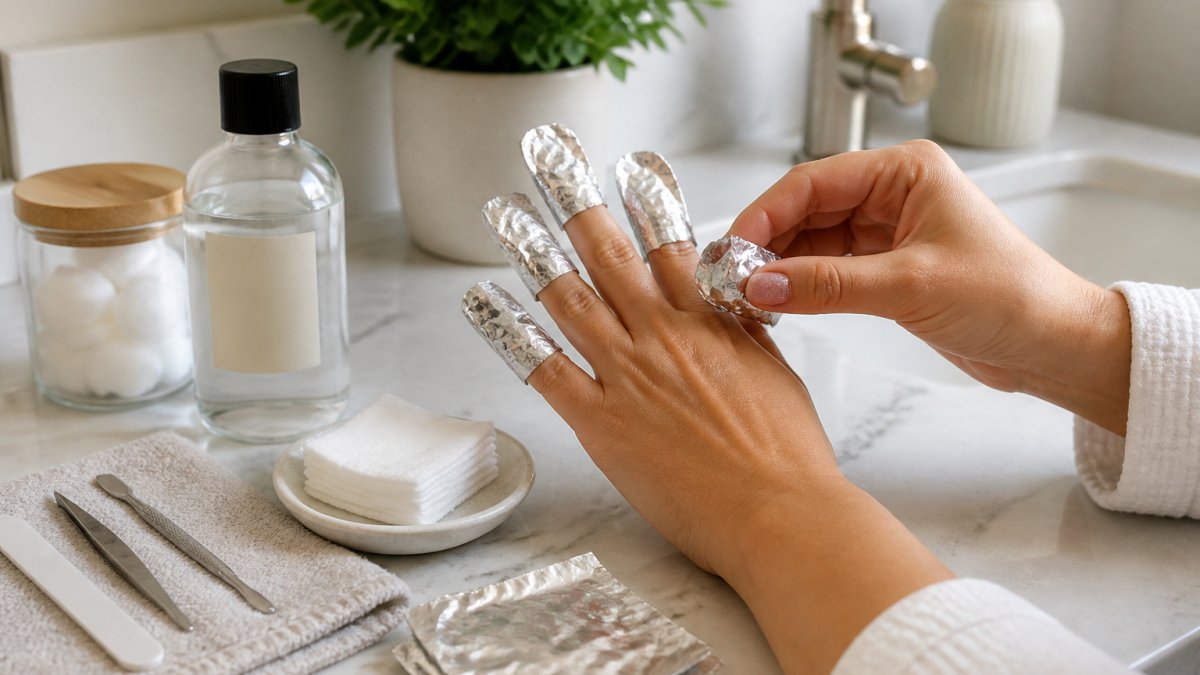
Step-by-Step Acetone Removal
Work in a well-ventilated room and open a window if you can. Acetone fumes build up quickly in a small bathroom.
- File the top coat. Use a coarse nail file to gently scuff the shiny surface of each nail. This lets acetone reach the powder layers underneath.
- Soak the cotton. Saturate a cotton ball or pad with 100% acetone.
- Wrap each nail. Press the soaked cotton onto the nail, then wrap a square of aluminum foil tightly around the fingertip to hold it in place.
- Wait. Leave the wraps on for 15 to 20 minutes, following the timing guidance from SNS Nails' removal guide.
- Check and re-wrap. After 15 minutes, unwrap one nail. If the powder has softened, continue. If not, re-wrap and wait another 5 minutes.
- Push off gently. Use an orange stick or cuticle pusher to push the softened powder from the cuticle toward the tip. Never scrape hard.
- Buff and rinse. Lightly buff away any residue, then wash your hands and brush under the nails.
Expected result: The dip powder lifts away in soft flakes with no resistance. If you have to fight it, it needs more soak time, not more pressure.
How Long to Soak Dip Nails in Acetone
Soak time is not fixed, it depends on how the dip was applied, what is underneath it, and how warm the room is. Know the range and recognise when the resin has softened.
The baseline range
For a standard, single-colour dip over natural nails, expect 15 to 20 minutes in foil wraps, long enough for acetone to swell the cured resin so it lifts as a soft, gel-like mass rather than a hard flake.
What actually changes the timing
- Number of dip layers. Each dip-and-cure cycle adds resin density. A two-layer application softens in 10 to 15 minutes; a four-to-five-layer set needs 20 to 25.
- Top coat type. A thick, high-gloss top coat is the biggest barrier. If you have not filed through it, add 5 to 10 minutes.
- Ambient temperature. Acetone's solvency drops in a cold room. Below roughly 18°C, expect 5 to 10 minutes longer. Warm the room, not the acetone, which is flammable.
Timing reference
| Situation | Realistic soak time | What to watch for |
|---|---|---|
| Thin, 2-layer dip | 10-15 min | Powder lifts as soft flakes |
| Standard 3-layer dip | 15-20 min | Surface turns matte and gel-like |
| Thick or 4+ layers | 20-25 min | Check every 5 min; re-wrap if hard |
| Dip over tips or builder gel | 25-30 min for the dip only | Tips will not dissolve, file them |
| Cold room (under 18°C) | Add 5-10 min | Warm the room, not the acetone |
| Non-acetone remover | 30-90 min | Often still fails; expect heavy filing |
Troubleshooting: when it will not soften
If you have passed the 30-minute mark and the product is still hard, do not keep soaking or start scraping. Work through this checklist:
- Is the top coat actually broken? Run a fingernail across the surface. If it feels glossy and slick, the acetone never reached the resin. Dry the nail, re-file with a 180-grit file until matte, and re-wrap.
- Is the cotton saturated? A damp cotton ball dries out within minutes and stops working. It should be wet enough that a light press releases a drop.
- Is the foil sealed? Acetone evaporates fast. If the foil is loose at the sides, the solvent escapes. Press it firmly around the fingertip and fold the top closed.
- Is there a base layer underneath? Tips, forms, or a hard gel base will not dissolve. The dip on top comes away, but the base must be filed down by a professional or grown out.
- Is the product old or very thick? Heavily built-up dip from multiple fills can take two or three soak cycles. Re-file between cycles rather than extending one soak.
When to stop
Stop the soak and reassess if any of the following happens:
- Burning, stinging, or throbbing around the cuticle or under the nail. This usually means acetone has reached broken skin or an over-thinned nail plate. Remove the wraps, rinse with cool water, and let the nails rest at least 48 hours.
- Visible redness, swelling, or a rash spreading beyond the nail. This can indicate contact dermatitis or an allergic reaction to the resin. Do not reapply dip until it settles, and speak to a pharmacist or GP if it persists.
- The nail plate feels flexible or spongy when pressed. That signals over-thinning from filing, not softening. Further soaking and filing will make it worse.
A note on repeated removal
If you remove dip every two to three weeks, the cumulative effect of acetone and filing matters more than any single session. Most technicians recommend at least two weeks between dip sets to let the nail plate recover, longer if nails feel thin or bend easily. Frequent removal without a break is a common reason nails stay weak even when removal was done carefully.
How to Remove Dip Powder Nails Without Acetone
Non-acetone remover is the most common substitute people reach for, and the one most likely to end in frustration. Understanding why it struggles against dip powder helps you decide whether it is worth the extra time.
Why non-acetone remover struggles with dip powder
Dip powder is built on cyanoacrylate-based resins, the same chemistry used in nail glue and brush-on gel systems. Acetone (propanone) is a small, polar solvent that penetrates and swells those cured resins, breaking the cross-linked bond so the product lifts as a soft, gel-like mass.
In practice, the solvent softens only the top fraction of the coating and leaves the lower layers intact. You end up filing more, soaking longer, and applying more force than with acetone, exactly the combination that thins the nail plate.
The non-acetone method, step by step
If you have a genuine acetone sensitivity (contact dermatitis, asthma triggered by ketone fumes, or a dermatologist's instruction to avoid it), this sequence gives the best odds:
- File aggressively but carefully. Use a 180-grit file to break through the top coat and as much colour as you can reach without seeing pink nail plate. Stop the moment you see the natural nail.
- Buff the remaining surface. A 240-grit buffer opens the resin so the solvent can bite.
- Soak cotton pads in non-acetone remover until wet but not dripping.
- Wrap with foil as you would for acetone, pressing the pad firmly against the nail.
- Wait 20 to 30 minutes. Check one nail at 20 minutes. If nothing has softened, re-wrap for another 10.
- Push off what has lifted with an orange stick. Do not chase stubborn patches.
- Re-file and repeat for remaining product. Expect two to three cycles for a standard dip set, more for a thick application.
Honest trade-offs
| Factor | Acetone | Non-acetone |
|---|---|---|
| Time to full removal | 15-30 min | 45-90 min, often longer |
| Effectiveness on dip powder | Reliable | Inconsistent; residue common |
| Odour and fumes | Strong, needs ventilation | Mild |
| Skin dryness | High | Moderate |
| Filing required | Light | Heavy |
| Best for | Most users | Acetone sensitivity, well-ventilated space unavailable |
When non-acetone is the right call
Non-acetone is worth choosing in three situations: a confirmed acetone allergy or sensitivity, a household where fumes are a genuine problem (small children, respiratory conditions), or a very thin, single-layer dip where the resin is less dense. Otherwise, acetone removes the product faster with less cumulative wear, and less filing is the biggest factor in how your nails look two weeks later.
Common Mistakes That Damage Your Natural Nails
The biggest mistake is treating removal like a race. Dip powder is designed to last, so it will not come off quickly without the right prep.
Watch for these errors:
- Skipping the filing step. Acetone cannot reach the powder through an intact top coat.
- Picking at lifted edges. The single most common cause of nail damage.
- Using too little acetone. A dry cotton ball does nothing. Soak it fully.
Aftercare: How to Help Your Nails Recover
Aftercare decides whether your nails bounce back or stay brittle for weeks. Acetone strips oil from the nail plate and surrounding skin, so recovery matters as much as removal.
Do this right after removal:
- Wash hands with mild soap and lukewarm water.
- Apply cuticle oil to each nail and massage it into the cuticle.
- Follow with a thick hand lotion to restore moisture.
- Keep nails bare for a few days so they can recover.
For the next week, moisturize twice a day. Cuticle oil is the most important product here. It reaches the nail plate where dryness starts.
If your nails feel thin or bend easily, take a break from dip powder. A two-week pause lets new growth strengthen the nail.
Conclusion
Removing dip powder at home is straightforward once you respect the process: file, soak, wait, and lift gently. Rushing any step causes damage, and no shortcut is worth weeks of weak, peeling nails.
Our press-on lashes need no glue, our formulas are gentle on sensitive eyes, and every kit is designed for fast application. If you want salon-quality results without the salon trip, our all-in-one kits make it simple.
Shop the Kit and get salon-quality lashes and brows, delivered to your door.
Frequently Asked Questions
How do you remove dip powder nails at home without damaging your natural nails?
Always start by filing off the top coat to break the seal. Soak cotton balls in acetone, wrap them around each nail with foil, and wait 15-20 minutes. Gently push off softened powder with a cuticle stick; never scrape hard. Follow with cuticle oil and hand lotion to restore moisture.
Can you remove dip powder nails without acetone?
Yes, but it takes longer. You can file the top coat, then soak nails in warm soapy water for 20-30 minutes, or use a non-acetone remover. These methods are gentler but may not fully dissolve thick dip layers. For stubborn spots, repeat the process.
What should you do after removing dip powder nails?
After removal, wash hands to remove residue, then apply cuticle oil and a rich hand lotion. Keep nails bare for a few days to let them recover. Trim and file any rough edges. Avoid picking or peeling to prevent damage.
How long does it take to remove dip powder nails at home?
With acetone and foil wraps, the soak takes 15-20 minutes, plus 10-15 minutes for filing and finishing. Total time is typically 30-45 minutes. Without acetone, expect 40-60 minutes. Thicker applications may need a second soak.
