



Press On Lashes vs Magnetic Lashes: Which Is Better?

Table of Contents
- Press On Lashes vs Magnetic Lashes: The Quick Verdict
- How Each Lash Type Attaches (And Why It Matters)
- Application Time and Skill Level Compared
- Wear Time, Durability, and Weather Resistance
- Sensitive Eye Lash Solutions: Glue vs Magnets
- Lash Damage Prevention: Protecting Your Natural Lashes
- How to Choose: Match the Lash to Your Lifestyle
- The Bottom Line: Which Falsies Win?
- Frequently Asked Questions
Last Updated: September 4, 2026
Press On Lashes vs Magnetic Lashes: The Quick Verdict
Magnetic lashes are the better choice for most people who want to avoid the mess and irritation of traditional eyelash adhesive, while press on lashes use a different mechanism entirely. The decision comes down to your tolerance for application fiddliness versus your need for a secure, long-wearing hold.
How Each Lash Type Attaches (And Why It Matters)
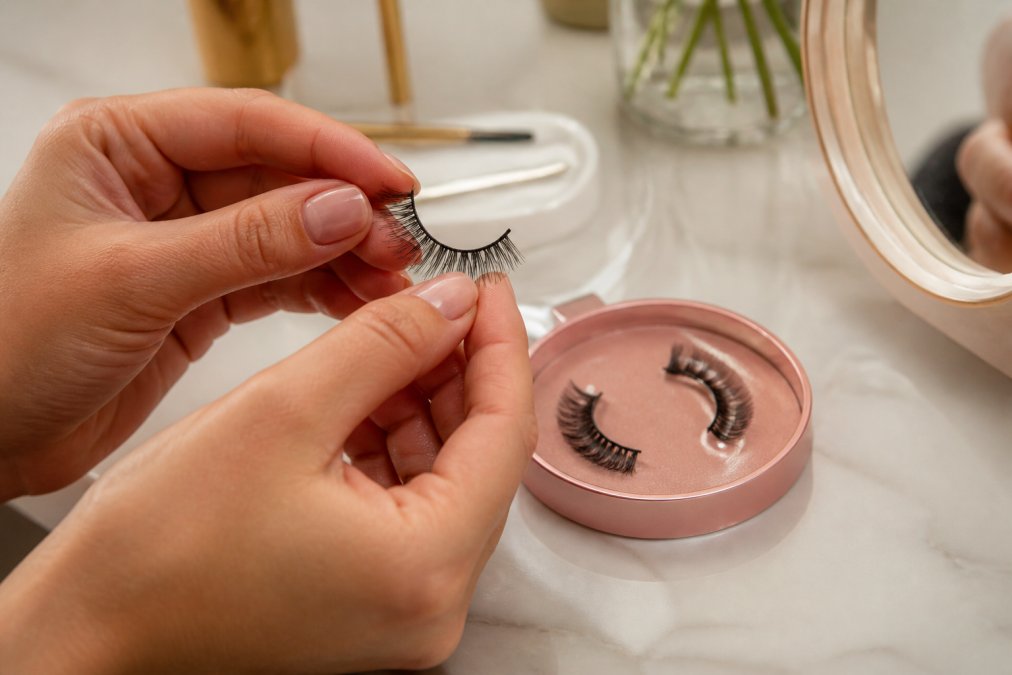
Press on lashes use a pre-applied adhesive strip that bonds to your lash line without any separate glue tube, whereas magnetic lashes rely on tiny magnets that clamp onto your natural lashes, either with a magnetic eyeliner or with a top-and-bottom lash sandwich.
Magnetic systems that use eyeliner require you to draw a precise line of liner containing iron oxide particles, which the magnets in the lash band then grip. Sandwich-style magnetic lashes skip the liner entirely, using micro-magnets to secure the lash between two layers. Press on lashes are simpler in theory: peel, align, and press, but the adhesive strip must make full contact with your natural lash line, and any gap creates a visible lift.
Application Time and Skill Level Compared
Magnetic lashes win on speed once you have practiced the placement, typically taking two to three minutes per eye, while press on lashes demand a steadier hand during initial alignment (peer-reviewed research). Magnetic liner systems fail when the liner line is uneven; press on lashes fail when the band is misaligned with your eye shape, causing the corners to pop up.
| Factor | Press On Lashes | Magnetic Lashes (Liner) | Magnetic Lashes (Sandwich) |
|---|---|---|---|
| Application time | 3-5 minutes per eye | 2-3 minutes per eye | 4-6 minutes per eye |
| Skill required | Moderate alignment | Precise liner line | High precision |
| Glue required | No separate glue | Magnetic eyeliner | No liner needed |
| Reusable | Yes, with care | Yes | Yes |
Wear Time, Durability, and Weather Resistance
For all-day wear through wind, rain, or a sweaty commute, magnetic lashes generally hold up better because the physical clamp of the magnets resists moisture, whereas press on lashes depend on the integrity of their adhesive strip. A press-on lash that gets wet may lose tack at the edges over several hours, while a magnetic lash can shift if the liner breaks down or if the magnets are too weak for your lash density.
Wind performance is a real concern that most guides ignore. Magnetic lashes with a weak grip will flutter or detach in a gust, and press on lashes with a stiff band may lift at the outer corner. If you live somewhere rainy or spend time outdoors, choose a lighter lash style and test the hold at home before committing to a full day out.
Sensitive Eye Lash Solutions: Glue vs Magnets
For sensitive eyes, magnetic lashes are the safer default because they remove eyelash adhesive from the equation, the most common trigger for allergic reactions and eye irritation. Many people who cannot tolerate latex-based glues still react to the cyanoacrylate compounds in "latex-free glue," so switching to magnets eliminates that whole category of risk (PubMed). Iron oxide in magnetic eyeliner is generally well tolerated, but it is not a guarantee; patch test any new liner on your wrist before applying it near your eyes.
Press on lashes with pre-applied adhesive still contain adhesive chemistry, just not in a tube you squeeze. If you have a history of reactions, look for hypoallergenic claims and check the ingredient list for the specific adhesive polymer. The American Academy of Ophthalmology guidance on eyelash extensions and adhesives advises caution with any product applied near the eye and recommends discontinuing use at the first sign of redness or swelling.
Ingredient-Level Troubleshooting: What Actually Triggers a Reaction?
Most guides stop at "check for hypoallergenic labels," but that advice is nearly useless because the term is unregulated. Here is a practical breakdown of the most common culprits in each system:
In lash adhesives (press-on strips and traditional glues):
- Latex (natural rubber latex): The classic allergen. Even "latex-free" formulas can contain cross-reactive proteins if they are manufactured in facilities that also process latex.
- Cyanoacrylate: The active bonding agent in most "latex-free" glues. It polymerizes on contact with moisture, which is what creates the strong hold. Sensitization to cyanoacrylate is increasingly common among regular false-lash users, and reactions often appear not on the first use but after weeks of repeated exposure.
- Formaldehyde resin: Used as a hardening agent in some strip adhesives. It is a known contact allergen and can cause eyelid dermatitis even at trace levels.
- Colophony (rosin): Sometimes added to improve tack. It is a frequent sensitizer in cosmetics and adhesives.
In magnetic eyeliner:
- Iron oxides (CI 77499, CI 77491): These are the magnetic particles that the lashes grip. True allergy to iron oxides is rare, but some people react to the binder system that suspends the pigment, not the pigment itself.
- Acrylates copolymer: A film-former that helps the liner dry down to a flexible film. Acrylate allergy is well documented in nail products and can cross-react with lash liner.
- Phenoxyethanol: A preservative used in many liners. It is generally well tolerated but can cause irritation in high concentrations on the delicate eyelid skin.
A Practical Patch-Testing Protocol
A wrist patch test is a reasonable first step, but eyelid skin is far more permeable than the wrist. A more reliable method is the behind-the-ear test: apply a small amount of the product behind your ear, leave it for 24 hours, and check for redness, itching, or swelling. If that area is clear, do a second test on the outer corner of your eyelid only, not the full lash line. Wait 48 hours before full application.
What to Do If You React Mid-Wear
If your eyes start burning or turning red while wearing either type, remove the lashes immediately. For press on lashes, use an oil-based cleanser to dissolve the adhesive before gently peeling. For magnetic lashes, slide the magnets apart first, then remove the liner with a gentle micellar water. Rinse your eyes with sterile saline solution and apply a cold compress if there is swelling. If symptoms persist beyond 30 minutes, or if you experience vision changes, seek medical attention promptly.
The Environmental Angle Most Guides Skip
Beyond personal sensitivity, there is a broader consideration: the waste footprint of each system. Press-on lashes are typically designed for single or limited reuse, and each pair comes in a plastic blister pack with a cardboard sleeve. Magnetic lashes, by contrast, are built for 25 to 30 wears, and the magnetic eyeliner tube lasts roughly 60 to 90 applications. Over a year of daily wear, a magnetic system generates a fraction of the packaging waste compared to buying a new press-on pair every one to two weeks. Some brands now offer refillable liner tubes and recyclable lash packaging, worth checking before you buy if sustainability factors into your decision. vegan foundation comparison.
Lash Damage Prevention: Protecting Your Natural Lashes
Lash damage prevention starts with removal technique, not application. Both magnetic and press on lashes can harm your natural lashes if you pull them off carelessly. Magnetic lashes that clamp too tightly can crush or bend natural lashes over time, especially if worn daily. Press on lashes that bond strongly can tear out natural lashes if removed without dissolving the adhesive first.
The safest removal routine for press on lashes involves an oil-based cleanser to break down the adhesive bond before gently peeling from the outer corner inward. Magnetic lashes release instantly when you slide them apart, but any tugging while they are still clamped risks pulling natural lashes. Never use oil-based makeup remover on magnetic lashes themselves; oil degrades the liner bond and can leave a residue that weakens future holds. Proper lash maintenance also means giving your natural lashes a break: avoid wearing falsies every single day, and brush your natural lashes with a clean spoolie to keep them from tangling.
Step-by-Step Removal: Press-On Lashes
- Soak a cotton pad with an oil-based cleanser (coconut, jojoba, or a dedicated eye makeup remover with oil).
- Press the pad against your closed eyelid for 20 to 30 seconds. Do not rub, the goal is to let the oil penetrate and dissolve the adhesive bond.
- Test the release: Gently lift the outer corner with your fingertip. If there is any resistance, apply more cleanser and wait another 15 seconds. Never pull against resistance.
- Peel from outer to inner corner in one slow, continuous motion, keeping the lash band parallel to your lash line rather than pulling upward.
- Clean the lash band with a cotton swab dipped in the same oil cleanser to remove residual adhesive before storing.
Step-by-Step Removal: Magnetic Lashes
- Slide the magnets apart, do not pull the lashes away from your eye. Pinch the outer edge of the top lash and the bottom lash together, then slide them sideways to disengage the magnets.
- Remove the magnetic eyeliner with a waterproof eye makeup remover (oil-free). Press a soaked pad against your closed lid for 10 seconds, then wipe gently downward.
- Check for liner residue on your lash line. Leftover liner can clog hair follicles and contribute to lash shedding over time.
- Clean the magnets with a dry microfiber cloth. Do not get the magnets wet; moisture can corrode them and reduce their grip strength.
The Hidden Risk: Mechanical Stress Over Time
Most discussions of lash damage focus on the moment of removal, but the bigger long-term risk is cumulative mechanical stress. Magnetic lashes that clamp too tightly can cause traction alopecia, a form of hair loss from prolonged pulling on the follicle. Warning signs include increased shedding of natural lashes, redness at the lash line, or a feeling of tightness or soreness after removal.
Press on lashes carry a different risk profile. Their adhesive bond is distributed across the entire band, which spreads the load more evenly than the point-pressure of magnets. However, if the band is too stiff or the adhesive is too aggressive, the constant tension on the outer corners can cause those lashes to shed prematurely.
How to Monitor Natural Lash Health
A simple self-check: once a month, take a photo of your bare lash line in natural light and compare it to the previous month. Look for thinning patches, gaps, or shorter lashes. If you notice a difference, reduce wear frequency and switch to a lighter lash style. Most practitioners find that natural lashes recover within 8 to 12 weeks if the damaging behavior stops, but persistent damage may require a break from falsies entirely.
The 48-Hour Rule for Lash Health
A practical guideline that most guides omit: give your natural lashes a full 48 hours of rest after every 3 to 4 consecutive days of wear. This allows the hair follicles to recover from the mechanical stress of clamping or adhesive bonding. During rest days, brush your lashes with a clean spoolie and apply a conditioning lash oil (castor oil or a dedicated lash serum) to support the natural growth cycle.
How to Choose: Match the Lash to Your Lifestyle
The right choice depends on your daily routine, your eye shape, and how much time you are willing to spend on precision application. Magnetic lashes suit frequent travelers and busy professionals because they are reusable and survive showers, but they require a steady hand with the liner. Press on lashes fit people who want a faster, glue-free application without the learning curve of magnet alignment, provided their eye shape matches the pre-curved band.
Consider your eye shape compatibility before buying. Deep-set eyes often struggle with both types because the lash band must follow a pronounced curve, while hooded eyes need shorter lashes that will not brush against the upper lid. A trimmable band helps, but it only fixes length, not curvature. If you have tried strip lashes and found them bulky or fake-looking, look for lightweight synthetic fibers and a thinner band in either category.
| Lifestyle | Best Choice | Why |
|---|---|---|
| Frequent traveler | Magnetic lashes | Survive flights and showers, reusable |
| Sensitive eyes | Magnetic lashes | No adhesive allergens |
| Beginner, unsteady hands | Press on lashes | No liner precision needed |
| Daily wear, budget-focused | Magnetic lashes | Higher cost per use over 25+ wears |
| Occasional, dramatic events | Press on lashes | Quick application for one night |
The Bottom Line: Which Falsies Win?
Magnetic lashes win for most people because they offer better durability, a genuinely glue-free experience, and a higher cost per use when you factor in reusability. Press on lashes are the better pick only if you find magnetic eyeliner application frustrating or if you want the fastest possible removal. For salon-quality results at home with no glue required, Kyro Beauty offers press-on lash kits designed for super-fast application that is gentle on sensitive eyes, with shower-proof formulas that hold through a full day of meetings or travel. The brand's all-in-one kits deliver long-lasting enhancement without the salon appointment, backed by more than 2,000 five-star reviews. Get started with Kyro Beauty and find a lash routine that protects your natural lashes while saving you time and money.
Frequently Asked Questions
Which is better, magnetic lashes or glue-on lashes?
It depends on your priorities. Magnetic lashes win for sensitive eyes and quick removal since no eyelash adhesive touches your skin. Glue-on lashes, including press-on styles with pre-applied adhesive, offer stronger hold through sweat and humidity. For beginners, magnetic lashes are easier to position because you can adjust them before the liner dries. Choose magnetic for convenience and eye comfort, or glue-on for maximum staying power during long events.
Are press-on lashes easier to apply than magnetic ones?
Press-on lashes are generally easier for first-timers. They come with adhesive already on the lash band, so you skip the separate magnetic eyeliner step and avoid alignment issues. Application takes under two minutes: press the band along your lash line and hold for 30 seconds. Magnetic lashes require precise liner placement or sandwich-style alignment, which takes practice. If you have steady hands and want reusable options, magnetic lashes work well once you master the technique.
Which false eyelashes are the least damaging to natural lashes?
Press-on lashes with pre-applied adhesive are among the least damaging options because they attach to the eyelid skin, not the natural lash shaft. This prevents the tugging that happens when removing traditional glue-on strips. Magnetic lashes are also gentle, but the magnetic eyeliner requires rubbing at removal, which can pull on delicate lid skin. For lash damage prevention, avoid waterproof mascara and oil-based cleansers with magnetic liners. Always remove falsies gently with a dedicated makeup remover.
How long do press-on lashes typically last compared to magnetic lashes?
For single wear, press-on lashes last through a full day and night, around 12 hours, and hold up well against sweat and light moisture. Magnetic lashes can also last 12 to 24 hours with a quality liner. The real difference is reusability. Quality magnetic lashes with micro-magnets typically last 25 to 30 wears with proper care. Press-on lashes are often disposable, though some premium brands offer reusable versions. Consider cost per use: reusable magnetic lashes become cheaper over time.
Are magnetic lashes safe for sensitive eyes?
Magnetic lashes are often safer than traditional glue because they skip latex-based eyelash adhesive, a common irritant. However, the magnetic eyeliner itself contains iron oxide and other pigments that can trigger reactions in very sensitive eyes. If you react to eyeliner, try sandwich-style magnetic lashes that use micro-magnets and skip liner entirely. For the gentlest sensitive eye lash solutions, press-on lashes with hypoallergenic pre-applied adhesive are a solid alternative. Always patch test any new product on your wrist first.
This article was written using GrandRanker
