
Why Brow Lamination Is Good for Thick Eyebrows

Table of Contents
- Why Brow Lamination Is Good for Thick Eyebrows
- How the Lamination Process Works on Coarse Hair
- Brow Lamination Aftercare for Thick Brows
- How Long Does Brow Lamination Last on Thick Hair?
- Best Brow Lamination Kit for Home Use
- Risks and Downsides for Coarse Hair
- Conclusion: Is Brow Lamination Right for Your Thick Brows?
- Frequently Asked Questions
Last Updated: September 19, 2026
Why Brow Lamination Is Good for Thick Eyebrows
Thick eyebrows are an asset, but they come with a maintenance problem that thin brows simply don't have. Coarse, dense hair grows in multiple directions, refuses to sit flat, and creates gaps that make even full brows look uneven. Brow lamination solves this by chemically relaxing the hair so it can be redirected into a uniform, upward shape. This treatment has moved from a niche salon service to a standard part of brow grooming, and the reason is straightforward: it works best on exactly the hair type that's hardest to manage.
According to Sugarlash Pro's 2026 industry trend report, brow lamination continues to grow in popularity, with a clear market shift toward softer, more natural-looking results. That shift matters for thick brows. Older lamination techniques over-processed coarse hair into a stiff, glued-down look. The current approach uses shorter processing times and gentler solutions to keep the hair pliable rather than rigid.
Here's the core insight most guides miss: thick eyebrows respond better to lamination than thin ones because there's more hair to work with. A brow artist can redirect individual hairs, fill visual gaps, and build a symmetrical shape without adding pigment or volume. Below, we'll break down how the process works on coarse hair, what aftercare actually requires, how long results last, and where the real risks sit.
How the Lamination Process Works on Coarse Hair
The lamination process has two chemical stages, and coarse hair needs a different approach at each one. A lifting solution breaks the disulfide bonds inside each hair, making it pliable enough to redirect. A neutralizing lotion then rebuilds those bonds in the new position, locking the hair into place.
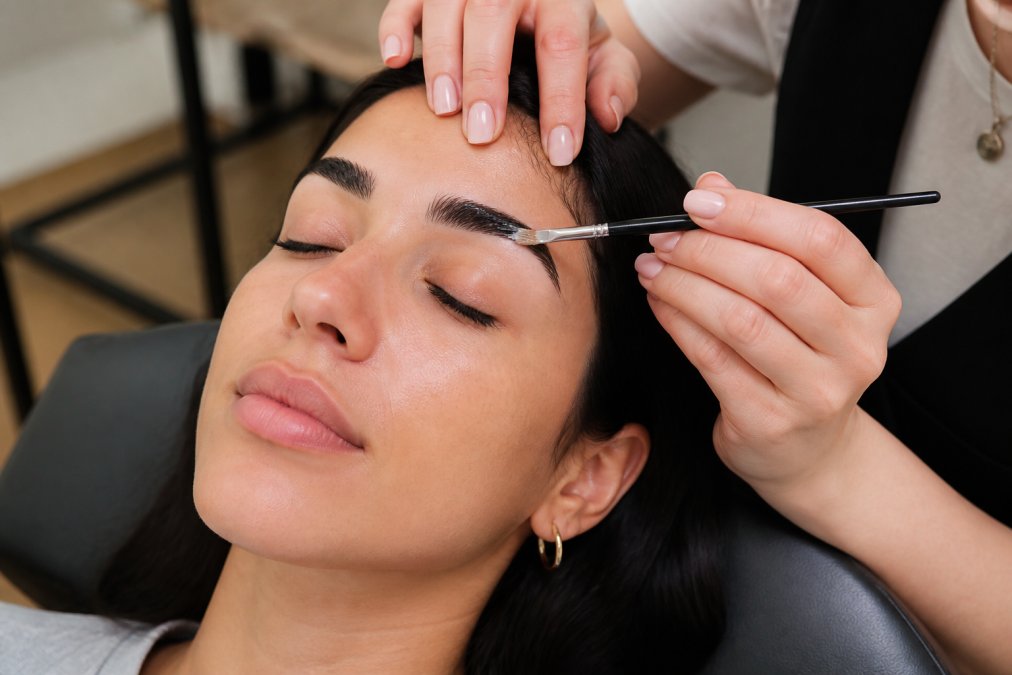
Thick, coarse hair has a denser follicle structure and a stronger natural curl pattern than fine hair. That's an advantage, because the hair holds a new direction well once set. It's also the risk: coarse hair absorbs chemical solution faster, so a processing time that suits fine brows will over-process thick ones.
Fides Baldesberger, CEO at Rubis Tweezers, explains the appeal in Women's Health's coverage of brow treatments: "It helps to redirect your natural brow growth and works on thin, thick or over-plucked eyebrows."
Professional guidance from Elan Cosmetics on brow direction and density points to the same two goals: symmetry and visual density. On thick brows, both come from direction rather than added product.
Brow Lamination Aftercare for Thick Brows
Brow lamination aftercare for thick brows is stricter than most people expect, because dense hair takes longer to fully settle. The first 24 hours decide whether your results last three weeks or six.
- Keep brows completely dry for the first 24 hours. No shower steam, no swimming, no cleanser on the brow area.
- Skip makeup, serums, and exfoliating acids on the brows for 48 hours.
- Brush the hairs upward daily with a spoolie to train the new direction.
- Apply a nourishing oil every night from day three onward. Hydration is what keeps laminated hair from turning brittle.
- Avoid saunas, steam rooms, and heavy sweating for the first two days.
That nightly oil step is the one people skip, and it's the one that matters most for coarse hair. Lamination is a semi-permanent chemical process, and the hair needs moisture restored to stay flexible through the brow growth cycle.
How Long Does Brow Lamination Last on Thick Hair?
Brow lamination typically lasts four to six weeks on thick hair, slightly longer than on fine brows. The reason is structural: coarse hair holds a set shape more stubbornly, so the redirect survives more washing and brushing before it relaxes.
The limit isn't the treatment, it's the hair growth cycle. Every brow hair eventually sheds and regrows in its natural direction. Once enough new hairs push through, the uniform shape breaks down and you'll see unruly strands reappearing at the root.
For thick brows, most people book a follow-up at the four-week mark. Some stretch to six weeks with disciplined aftercare. Going longer than that usually means the regrowth has undone the symmetry, and a brow artist will need to re-laminate from scratch rather than touch up.
A useful way to think about the timeline:
| Timeframe | What's Happening | What To Do |
|---|---|---|
| Days 1-2 | Bonds setting, hair fragile | Keep dry, no product |
| Days 3-14 | Peak result, shape locked | Daily spoolie, nightly oil |
| Weeks 3-4 | First regrowth appears | Assess symmetry, book if needed |
| Weeks 5-6 | Shape relaxing | Re-laminate or let it rest |
Best Brow Lamination Kit for Home Use
Most guides treat at-home lamination as a simple money-saver. For thick, coarse brows, that framing is backwards. The real question isn't whether a kit is cheaper than a salon visit, it's whether you can safely judge your own hair's tolerance for a chemical lifting solution when you can't see the back of your own brow line.
Here's the honest trade-off. A professional brow artist reads your hair mid-process: they watch for the first sign of over-relaxation, they know your follicle density from a patch test, and they can stop the clock early. A home kit gives you a fixed timer and a mirror. On fine brows, that gap is manageable. On coarse, dense brows, the hair type that absorbs lifting solution fastest, it's the difference between a clean lift and a snapped, frizzy result.
That doesn't mean home kits are off the table. It means the kit you choose matters more for thick brows than for any other hair type. Three things separate a kit that's safe for coarse hair from one that isn't:
- Short, staged processing times. A kit that tells you to check at 4 minutes, then 6, then 8 is safer than one that says "leave for 10." Coarse hair can go from pliable to over-processed inside a two-minute window.
- A neutralizing step you cannot skip. The neutralizer rebuilds the disulfide bonds in their new position. Kits that fold this into a single "develop and set" cream remove your ability to stop the lift early.
- A patch test protocol. Any kit worth using on thick brows should instruct you to test on a small section 24-48 hours before a full application. If it doesn't, that's a red flag.
Kyro Beauty's all-in-one brow kits combine shaping and tinting in a single kit, use a shower-proof formula, and are designed to be gentle on the sensitive skin around the eyes.
Risks and Downsides for Coarse Hair
If you're unsure whether your brows need a rest, ask a brow artist to assess the hair shaft under magnification. A healthy laminated brow should still feel slightly flexible; one that feels stiff and dry at the root is telling you it needs a break.
Conclusion: Is Brow Lamination Right for Your Thick Brows?
Thick eyebrows are the best candidate for brow lamination, provided the treatment is timed for coarse hair rather than fine hair. The redirecting effect tames unruly hairs, builds a symmetrical brow shape, and creates a fuller appearance without pigment or extensions. The risks are real but manageable: over-processing, skipped aftercare, and stacking sessions too close together.
Frequently Asked Questions
Does brow lamination make your eyebrows thicker?
Brow lamination does not add new hair, but it makes existing thick brows look fuller by lifting and redirecting coarse hairs upward. This creates a fluffy, dense appearance that lasts 6 to 8 weeks. For those with sparse areas, the treatment can make the most of what you have, but it will not fill in gaps where no hair grows. If you want added volume, combine lamination with tinting or a brow serum.
What are the downsides of brow lamination for coarse hair?
Coarse hair can be more prone to over-processing, which may lead to brittleness, breakage, or a stiff, unnatural look if the chemical solution is left on too long. Some users also find that aggressive brushing creates an overly styled appearance. To reduce risks, choose a soft technique, follow aftercare advice, and avoid repeating the treatment sooner than every 6 to 8 weeks. A patch test is essential to check for reactions.
How long does brow lamination last on thick hair?
Results typically last 6 to 8 weeks on thick hair, though this varies with your natural growth cycle and aftercare. Thick, coarse hairs may hold the shape slightly longer than fine hair because they are stronger, but they also tend to grow back quickly. Using a nourishing oil daily and avoiding harsh products will help extend the effect. Most people book a follow-up appointment every two months.
Can brow lamination help with unruly or downward-growing brows?
Yes. Lamination redirects hair growth by breaking down the bonds inside each hair, allowing you to set them in an upward, uniform direction. This is especially helpful for thick brows that grow sideways or downward. As Fides Baldesberger, CEO at Rubis Tweezers, told Women's Health in 2024, 'It helps to redirect your natural brow growth and works on thin, thick or over-plucked eyebrows.' The effect is semi-permanent and can be maintained with regular sessions.
